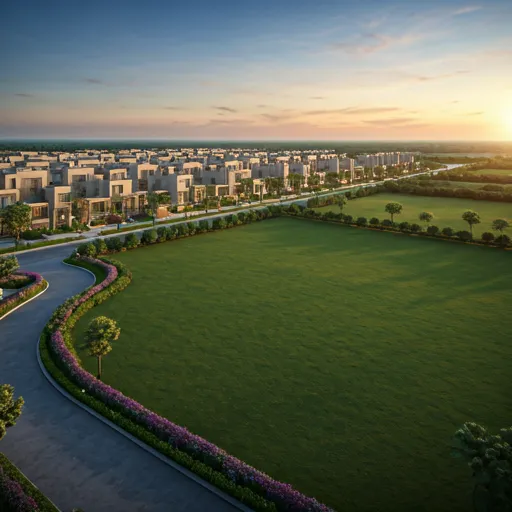
“Urban development is not just about building infrastructure. It is also about creating opportunities for landowners to participate in a region’s growth.”
Across Maharashtra’s evolving economic landscape, the definition of progress is undergoing a profound and necessary shift. For decades, urban growth was viewed strictly through the lens of concrete, steel, and physical acreage.
However, genuine regional transformation cannot be separated from the people whose heritage and livelihoods are tied to the soil.
According to a recent report by the Free Press Journal, the Mumbai Metropolitan Region Development Authority (MMRDA) has secured 216 acres in Raigad’s Pen growth corridor, supported by strong landowner participation and a framework offering different land compensation options.
This approach highlights an important and often overlooked aspect of real estate development: transparency and informed participation can help build enduring confidence among all stakeholders.
Transparency and the Power of Informed Participation
Historically, large-scale land acquisition in India often encountered friction, delays, and understandable resistance when landowners felt sidelined or inadequately informed about the long-term future of their holdings.
When authorities adopt a transparent dialogue and present flexible compensation models—allowing landowners to participate in future value appreciation rather than facing abrupt displacement—the dynamic changes completely. Cooperation replaces contention.
When options are clearly explained, legal frameworks are made accessible, and landowners have a choice between upfront financial compensation or developed plots, mutual trust replaces speculative fear.
Instead of wealth concentrating purely in the hands of secondary speculators, inclusive models ensure that agrarian families and native stakeholders directly share in the wealth created by regional master planning.
In my 26 years of navigating land banking and development across Navi Mumbai and Raigad, I have consistently seen that the most resilient and peaceful developments are those where local stakeholders are treated with respect, clarity, and fairness from day one.
Raigad’s Long-Term Trajectory: Atal Setu & NMIA
With infrastructure such as Atal Setu (Mumbai Trans Harbour Link) and the upcoming Navi Mumbai International Airport (NMIA) influencing regional connectivity, Raigad’s long-term potential deserves serious attention.
What was once considered a distant, agrarian hinterland has suddenly been brought within a 20-to-40-minute drive of South Mumbai and the financial core. The Pen corridor, strategically positioned adjacent to Panvel, Chirle, and JNPT, stands directly in the path of this outward economic wave.
Sanctioned Regional Plans (RP) and Development Plans (DP) that clearly designate residential, commercial, green, and industrial zones.
Reliable potable water supply schemes, modern drainage networks, underground electrical cables, and healthcare facilities.
High-tech logistics hubs, warehousing corridors, and industrial parks that create sustainable local livelihoods rather than commuter dormitory towns.
However, as I often remind investors and partners, sustainable growth will depend on effective planning, civic amenities, and employment opportunities. Infrastructure creates the initial spark, but institutional planning sustains the fire.
Essential Due Diligence for Investors & Landowners
When high-profile infrastructure projects catch headlines, enthusiasm in the real estate market surges rapidly. But optimism must never replace discipline.
For investors and landowners, understanding legal documentation, development plans, and the terms of any transaction remains essential.
-
1
Scrutinize Complete 30-Year Revenue Records: Inspect 7/12 extracts, Ferfar (mutation entries), and ensure clear, unencumbered freehold ownership with no ancestral disputes or ceiling restrictions.
-
2
Cross-Reference Sanctioned Development Plans (DP/RP): Verify how official transit corridors interact with local zoning, checking green zones, flood reservations, and road-widening alignments.
-
3
Understand the Precise Terms of Every Transaction: Scrutinize legal clauses, title search certificates issued by experienced land advocates, and formal compensation disbursement conditions.
-
4
Verify Last-Mile Motorable Public Access: Ensure that properties enjoy verified, legally demarcated road connectivity rather than unnotified village trails or private easements.
-
5
Partner with Established Developers with Local Heritage: Work with developers deeply rooted in the region who possess 100% title clarity, complete legal transparency, and a multi-decade track record.
The True Measure of Development
Real estate in Raigad is standing at a historic inflection point. The combination of mega-infrastructure, institutional capital, and progressive urban planning is unlocking potential that lay dormant for decades.
Yet, we must never lose sight of what truly creates lasting value.
The real value of development lies not only in transforming land, but in creating lasting opportunities for the people connected to it.
When landowners are empowered, when documentation is crystal-clear, and when planning prioritises civic infrastructure alongside connectivity, regional growth ceases to be a speculative bubble—it becomes an enduring legacy.
“The real value of development lies not only in transforming land, but in creating lasting opportunities for the people connected to it.”

About Binod Agarwal
Binod Agarwal brings 16 years of service in the Indian Armed Forces and over 26 years of real estate, governance, and business experience across Navi Mumbai and Maharashtra. His philosophy has always anchored in clear titles, ground verification, and long-term generational wealth.