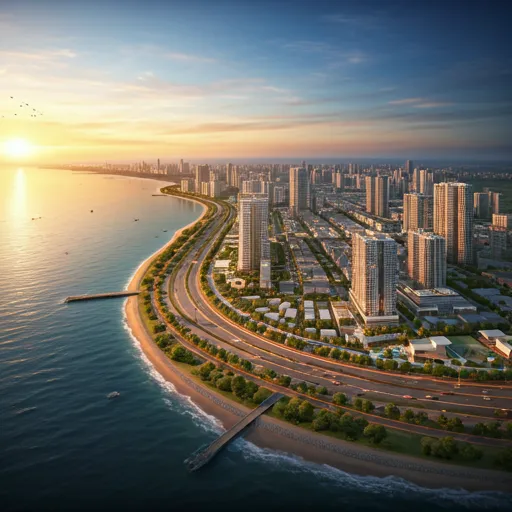
“As Navi Mumbai Airport becomes an increasingly important part of the region’s infrastructure landscape, the way this transition is managed will matter as much as the infrastructure being developed.”
The development of the Navi Mumbai International Airport (NMIA) represents one of the most critical infrastructure undertakings in the history of the Mumbai Metropolitan Region (MMR). As an ultra-modern greenfield facility, it is designed to unlock vital airspace and passenger capacity that Mumbai’s single-runway constrained hub has desperately needed for decades.
As the region prepares for the next operational phase of airport readiness, coordinating flight operations between Mumbai and Navi Mumbai has emerged as a significant and intricate planning exercise.
In a major recent development, Mumbai International Airport Ltd (MIAL) has asked airlines to submit structured transition plans by 3 November for temporarily shifting some international flight operations to Navi Mumbai International Airport.
This proposed transition is directly linked to the comprehensive redevelopment and modernisation of Terminal 1 (T1) at Mumbai’s existing Chhatrapati Shivaji Maharaj International Airport (CSMIA).
Why the Transition Requires Careful Planning
Moving international flight operations between two major airports involves far more than simply reallocating takeoff and landing slots on a schedule board. It represents a massive operational recalibration across multiple intertwined civil aviation domains.
Airlines must assess their global schedule connectivity, aircraft turnaround times, maintenance rotations, crew accommodation, and—crucially—passenger transit connections between domestic and international flights. Simultaneously, airport operators must coordinate runway capacity, ground handling infrastructure, and construction timelines for terminal redevelopment.
The transition has also highlighted differing perspectives between the airport operator and international airlines over the proposed changes. Carriers have voiced concerns regarding passenger transit inconvenience between South/Central Mumbai and Ulwe/Panvel, connecting passenger transfers, and the commercial viability of split operations before high-speed rail or dedicated metro transit corridors are operational.
This debate underlines the absolute importance of open stakeholder consultation, transparent operational information, and a workable, collaborative implementation plan.
Carriers operate tightly sequenced departure and arrival banks. Moving flights to NMIA requires re-slotting bilateral flight rights and coordinating feeder flights across regional domestic networks.
Passengers connecting between domestic flights at CSMIA and international flights at NMIA need predictable, rapid inter-airport transit across the harbour without luggage redispatch burdens.
Customs, immigration, air traffic control protocols, baggage handling systems, and perishable cargo cold chains must operate with zero teething issues from day one.
A phased, well-coordinated approach can help manage these operational challenges effectively while allowing the necessary redevelopment work on Mumbai’s Terminal 1 to progress without grounding the city's aviation traffic.
What It Means for the Region
The simultaneous operation of two major airports serving the Mumbai metropolitan region has the potential to transform MMR into a dual-hub aviation powerhouse, comparable to London (Heathrow and Gatwick), Tokyo (Haneda and Narita), or New York (JFK, Newark, and LaGuardia).
Expanding aggregate aviation capacity relieves Mumbai's heavily saturated single-runway system, creating room for new direct international routes to North America, Europe, East Asia, and Australasia.
Beyond aviation metrics, the economic ramifications for the surrounding Navi Mumbai, Raigad, Panvel, and NAINA districts are immense. Airports serve as magnetic employment centres. The influx of international flight operations naturally accelerates demand for:
Multinational corporate headquarters, airline crew hotels, convention centres, and air-freight logistics parks flourish in direct proximity to international runways.
Aviation professionals, engineers, corporate executives, and hospitality staff seek premium, title-clear gated residential plots and homes within a 30-minute commute of the aerodrome.
Better coordination between the two facilities will be essential as physical infrastructure and daily flight operations evolve.
Balancing Infrastructure With Operational Continuity
In my view, the key measure of success will be how effectively the transition balances infrastructure development with the needs of airlines and passengers. Capacity expansion is valuable, but so are reliability, accessibility, and operational continuity.
A grand terminal building is only as good as the passenger experience it delivers. If travellers face unpredictable road congestion reaching the terminal or if airlines suffer scheduling disruptions, the economic dividend of the project is compromised.
-
1
Collaborative, Phased Airline Migration: Rather than imposing arbitrary mandates, transition plans must be developed in deep partnership with carriers, starting with point-to-point routes and chartered cargo before shifting complex international transit banks.
-
2
High-Speed Inter-Airport Transit Priority: Accelerating dedicated rapid transit solutions—including express airport shuttle corridors via Atal Setu and the fast-tracked CSMIA-NMIA Metro Line 8—to compress travel time between terminals under 45 minutes.
-
3
Flawless Support & MRO Ecosystem: Ensuring aviation fuel hydrants, line maintenance, catering, customs clearance, and airline crew lounges are fully staffed, tested, and operational ahead of commercial rollouts.
-
4
Surrounding Urban & Civic Integration: Aligning NAINA and CIDCO development plans so that access roads, water infrastructure, and orderly residential townships in Panvel and Raigad scale synchronously with airport passenger footfalls.
The request for transition plans by 3 November marks another step in this historic process. The next phase will depend on genuine stakeholder coordination and the practical arrangements agreed upon for shifting operations smoothly.
As Navi Mumbai Airport becomes an increasingly important part of the region’s infrastructure landscape, the way this transition is managed will matter as much as the infrastructure being developed.
“Capacity expansion is valuable, but so are reliability, accessibility and operational continuity. The request for transition plans marks another step in this process; disciplined execution will define its lasting success.”

About Binod Agarwal
Binod Agarwal brings 16 years of service in the Indian Armed Forces and over 26 years of real estate, governance, and business experience across Navi Mumbai and Maharashtra. His philosophy has always anchored in clear titles, ground verification, and long-term generational wealth.